What’s the Best Material for Outdoor Kitchen Countertops? Top Options for Durability
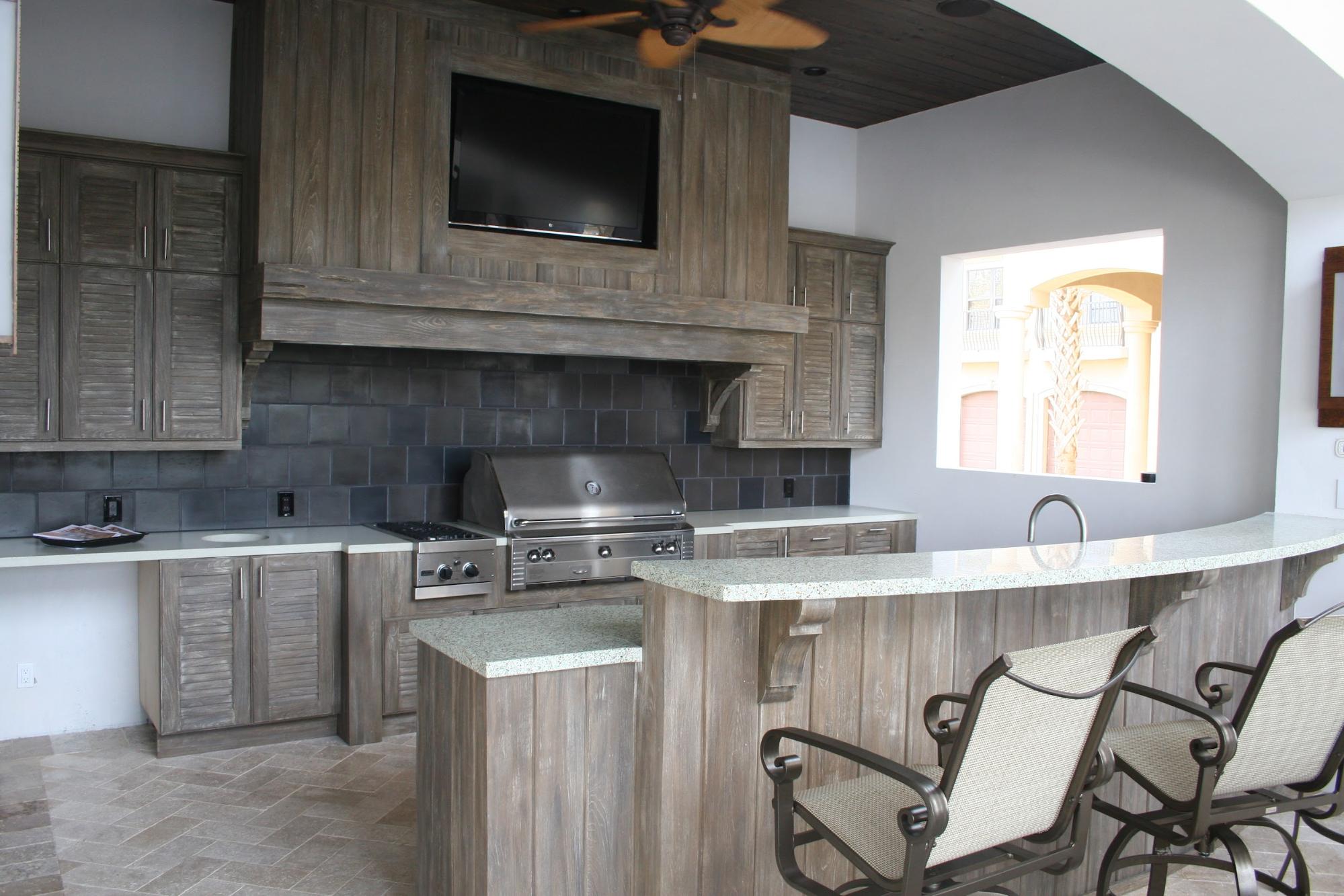
The material you choose for your outdoor kitchen countertops will determine how your space looks, how long it lasts, and how much upkeep you’re dealing with years down the road. Unlike an indoor kitchen, your outdoor surfaces are in the thick of it every day. They’ll face blazing summer sun, Michigan rain and snow, greasy drips, and everything in between.
Choose well, and your countertops will be as tough as they are stunning. Choose poorly, and you could be dealing with cracking, staining, and/or fading before the warranty on your new grill even expires.
So what’s the best material for outdoor kitchen countertops? Here’s what you need to know.
Key Takeaways
- Porcelain is our top recommendation for outdoor kitchen countertops thanks to its UV resistance, freeze-thaw durability, and low-maintenance performance.
- Granite is the natural stone champion that’s virtually indestructible and has a one-of-a-kind look.
- Stainless steel and concrete are also good choices for some homeowners.
- While popular indoors, quartz is not recommended for outdoor Michigan kitchens unless specifically UV-graded.
- Don’t overlook your cabinetry. Weatherproof outdoor cabinets are just as critical as your countertop for durability and a polished look.
The Importance of Choosing a Great Outdoor Kitchen Countertop Material
Indoor countertops face heat, knives, and spilled coffee. Outdoor countertops face all of that plus direct UV radiation, freeze-thaw cycles, wind-driven rain, and the kind of temperature swings that can push 100°F in a single day here in Michigan. The wrong material can crack, warp, fade, or absorb staining liquids and harbor bacteria.
According to the National Association of Home Builders, outdoor living spaces have become among the most requested features in new home construction and remodeling projects. That means homeowners are investing in full outdoor kitchens, and if you want to get your money’s worth out of your investment, it’s important you choose a quality countertop.
Before we explain the top outdoor countertop materials in depth, here’s a high-level comparison to help frame your decision.
| Material | Durability | UV Resistance | Maintenance | Heat Resistance | Est. Lifespan |
| Porcelain | 5/5 | 5/5 | Very low | Moderate | 25+ years |
| Granite | 5/5 | 5/5 | Moderate (seal 1-2xyr) | Excellent | 50+ years |
| Stainless Steel | 4/5 | 5/5 | Low | Excellent | 20-30 years |
| Concrete | 3/5 | 3/5 | High (regular sealing) | Good | 10-20 years |
| Quartz* | 4/5 | 3/5 | Very low | High | 25+ years |
Ratings reflect general outdoor performance. Lifespan estimates assume proper installation and maintenance.
*Quartz requires UV-stable, outdoor-rated product lines. See our note below.
Porcelain: The Best Overall Material for Outdoor Kitchen Countertops
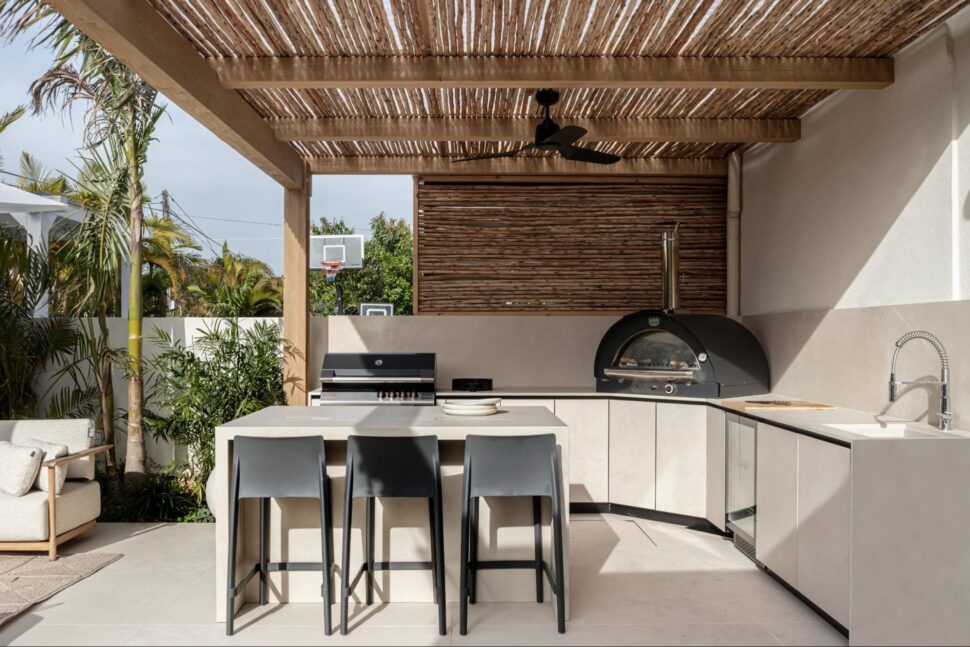
Best for: Homeowners who want maximum frost and UV resistance with a modern, seamless look and zero sealing requirements. Particularly well-suited to Michigan’s four-season climate.
When our team recommends a countertop for an outdoor kitchen, porcelain is often the first option we discuss, especially premium porcelain surfaces like Dekton.
Porcelain has been around forever in flooring and tile work, but large-format porcelain slabs become one of the fastest-growing choices for outdoor kitchens because they’re engineered specifically to handle harsh environmental conditions without sacrificing appearance.
Here’s what makes porcelain such a strong outdoor countertop material:
- Completely non-porous. Porcelain is fired at extremely high temperatures, which makes it denser and less porous than granite. Rain, humidity, oils, and food residue have nowhere to go — they wipe right off.
- UV and fade resistant. Porcelain’s color and finish are baked into the material during the firing process, so UV radiation won’t bleach or dull the surface over time.
- Frost and freeze resistance. For Michigan homeowners especially, this matters. Large-format porcelain slabs are rated for freeze-thaw cycles, which means your countertop can handle being buried under a February snowstorm without cracking.
- Scratch and stain resistant. Porcelain is rated 7-8 on the Mohs hardness scale. You’d have a hard time scratching it with anything short of a diamond.
- Minimal maintenance. Porcelain never needs sealing. Most messes clean up with mild soap and water.
DESIGN NOTE:
Large-format porcelain slabs (think 60”x120” or larger) give you the cleanest look with minimal grout lines. Avoid traditional small-tile porcelain for outdoor countertops, as the grout lines become a maintenance headache.
Best in Brands: Dekton Porcelain Countertops
Dekton is one of the leading ultra-compact porcelain surfaces for outdoor kitchens because it’s specifically designed to handle UV exposure, moisture, scratches, stains, and thermal shock. It offers the sleek, modern appearance homeowners want while delivering exceptional performance in four-season climates like Michigan. It’s also available in a range of colors and finishes, including styles that mimic natural stone and concrete.
Stop into one of our Standard locations to see Dekton samples in person.
Granite: The Natural Stone That Can Last a Lifetime
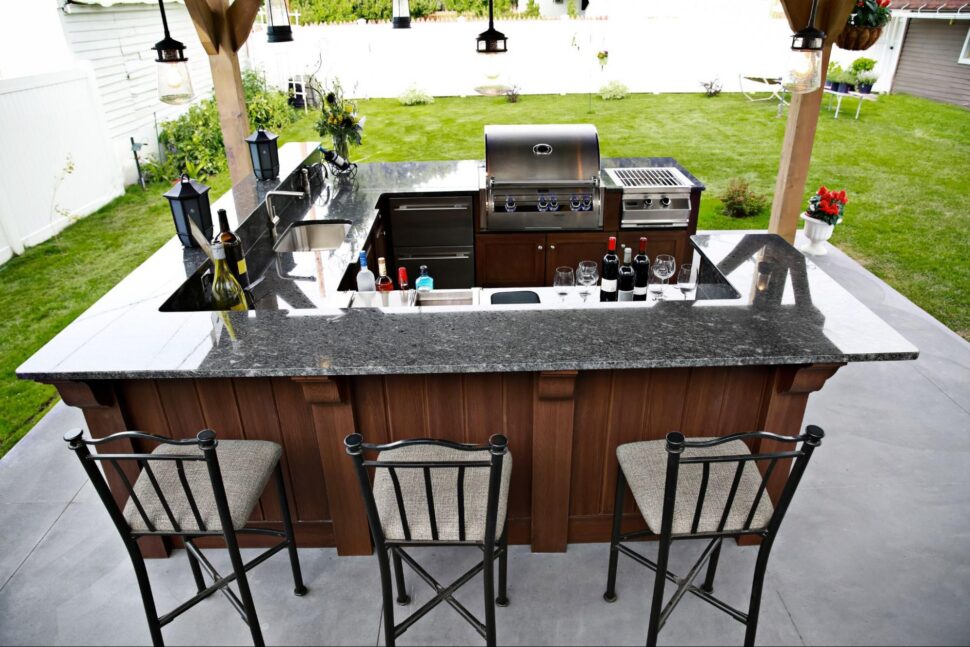
Best for: Homeowners who prioritize natural aesthetics, maximum heat resistance, and generational durability — and who don’t mind committing to annual sealing.
If porcelain is the modern performance leader, granite is the time-tested natural legend. Used for centuries in high-traffic applications, granite is one of the hardest natural materials on Earth, and it performs really well in outdoor environments.
Granite works well outdoors because of its:
- Exceptional heat resistance. Granite can withstand very high temperatures without damage, making it ideal for outdoor cooking where hot pans, grill grates, and direct flame proximity are a reality. You can set a hot cast iron skillet on granite without worry.
- Great durability. Granite is one of the densest natural stones available, resisting chipping, scratching, and impact well. When properly installed and sealed, granite countertops can last 50 years or more.
- Natural UV resistance. Because granite is a natural stone with no synthetic resins or binders, UV radiation doesn’t cause the same discoloration risks associated with some engineered materials, like quartz.
- Unique aesthetic. Each granite slab is genuinely one-of-a-kind. The natural veining, flecks, and movement of granite add depth and character to outdoor kitchens that engineered materials can’t always replicate.
Granite’s One Trade-off: Sealing
Granite’s one significant drawback is porosity. Because it’s natural stone, granite needs to be sealed on installation and then re-sealed once or twice per year outdoors, where exposure to moisture and temperature cycles is more intense than indoors. Skipping this step can lead to staining and surface degradation over time.
For many homeowners, this trade-off is entirely worth it for granite’s longevity and beauty. For others, especially those who want a “set it and forget it” surface, porcelain or quartz may be a better fit.
Stainless Steel: The Professional’s Choice for Hygiene
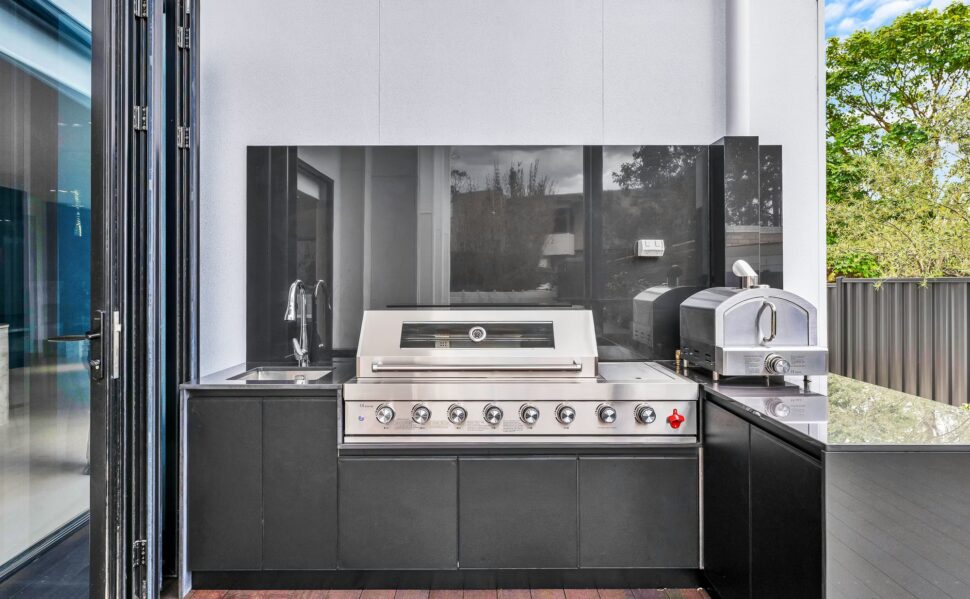
Best for: Homeowners who want a commercial-grade cooking surface that prioritizes sanitation and heat resistance.
Stainless steel is the material of professional restaurant kitchens for good reason: it’s nearly indestructible, completely non-porous, and laughs at heat. For outdoor kitchen enthusiasts who take their cooking seriously, stainless steel can bring a utilitarian edge to the backyard.
The advantages of stainless steel outdoors:
- Unmatched hygiene. Stainless steel is non-porous and bacteria-resistant, making it the most sanitary countertop surface available. Raw meat prep, marinades, fish — none of it lingers.
- Exceptional heat resistance. You can place hot pans, grill grates, and cast iron directly on stainless steel without damaging it.
- Rust and corrosion resistant. High-grade stainless (304 or 316 series) handles rain, humidity, and outdoor exposure well.
- Easy to clean. Wipe it down and it’s done. No sealing or special products required.
The Stainless Steel Trade-offs to Know
Stainless steel scratches over time, though many homeowners find this develops into an attractive “worked” patina. It can also get quite hot in the direct summer sun, and it has an industrial aesthetic that doesn’t suit every outdoor kitchen design.
Concrete: The Designer’s Choice for Custom Outdoor Kitchens
Best for: Homeowners who want a fully custom look and are willing to invest in regular maintenance to preserve it.
Concrete is the most customizable countertop material on the list. It can be cast in virtually any shape, tinted to any color, embedded with decorative aggregates, and finished with different textures (polished, brushed, exposed aggregate, etc.).
What concrete offers outdoors:
- Complete design freedom. Custom molds mean you can match any shape, edge profile, or layout, including integrated sinks and built-in features.
- Solid durability when sealed. Properly installed and maintained concrete is heavy, stable, and resistant to impact.
- Heat resistant. Concrete handles high heat without damage.
- Natural, earthy aesthetic. Concrete pairs beautifully with wood, stone, and metal elements.
Concrete’s Maintenance Commitment
If you’re drawn to concrete, go in with realistic expectations about upkeep. Concrete is porous and requires regular sealing — at minimum once per year, and more frequently in high-rain climates like Michigan. Without consistent sealing, concrete stains easily and can develop hairline cracks over freeze-thaw cycles. It’s also one of the heavier countertop materials, which means your cabinetry and base structure need to be built to support the weight.
| Should I Use Quartz for an Outdoor Kitchen Countertop?Quartz is one of the most popular countertop materials in the world. We carry quartz and love it indoors because it’s non-porous, durable, low-maintenance, and available in dozens of colors and styles. That said, standard quartz is not recommended for outdoor kitchens. It’s an engineered stone, meaning it’s made from natural quartz crystals bound together with polymer resins. Those resins can be vulnerable to prolonged UV exposure and yellow, fade, or break down over time when left in direct sunlight. There are UV-stable, outdoor-rated quartz product lines specifically engineered to handle sun exposure. If you have your heart set on quartz, it’s not out of the question, but you need to confirm the specific product is rated for outdoor use before purchasing. Ask your supplier directly and don’t assume standard interior quartz will hold up the same way outdoors. Pro Tip: If you want the low-maintenance performance of quartz without the UV concerns, porcelain is the closest equivalent — and it’s engineered to handle outdoor exposure from the start. |
How to Maintain Outdoor Kitchen Countertops
Even the most durable countertop material needs a little attention to stay looking its best year after year. Here’s a practical checklist by material.
Porcelain
Clean with a damp cloth and mild detergent.
For stubborn grease, use a non-abrasive cleaner marketed as safe for porcelain surfaces.
Inspect edges and corners annually, as porcelain’s one vulnerability is chipping at edges under sharp impact.
Clean grout as needed with a non-abrasive cleaner.
Granite
Reseal with a penetrating stone sealer once or twice per year, or more frequently in high-rain or humid climates.
Wipe up spills quickly, especially acidic liquids like citrus juice, wine, or tomato sauce.
Use pH-neutral cleaners; avoid vinegar, bleach, or ammonia-based products that can degrade the sealant.
Inspect for chips or cracks after winter and address promptly with stone epoxy if needed.
Stainless Steel
Wipe down with a damp cloth and mild dish soap. Dry thoroughly to prevent water spots.
Clean with the grain of the metal (not against it) to minimize visible scratching.
Use a stainless steel cleaner or food-grade mineral oil seasonally to maintain the finish.
Cover during extended periods of non-use in winter.
Concrete
Reseal at least once per year with a penetrating concrete sealer (more often in high-moisture climates.
Wipe up spills immediately, especially oils and acidic liquids.
Use pH-neutral cleaners; avoid vinegar or citrus-based products.
Inspect annually for hairline cracks and address with concrete filler before they expand through freeze-thaw cycles.
Don’t Forget the Cabinets: Why Weatherproof Cabinetry Is Just as Important
A premium outdoor countertop sitting on top of subpar cabinetry is a recipe for disaster. Standard indoor cabinetry will warp, rot, crack, and fail outdoors within a few seasons. Your cabinetry needs to be engineered for outdoor life just as much as your countertops do.
For outdoor cabinetry, we recommend NatureKast. NatureKast makes the gold standard in outdoor kitchen cabinetry, built from a high-density resin system that’s completely impervious to the elements that destroy traditional wood cabinetry.
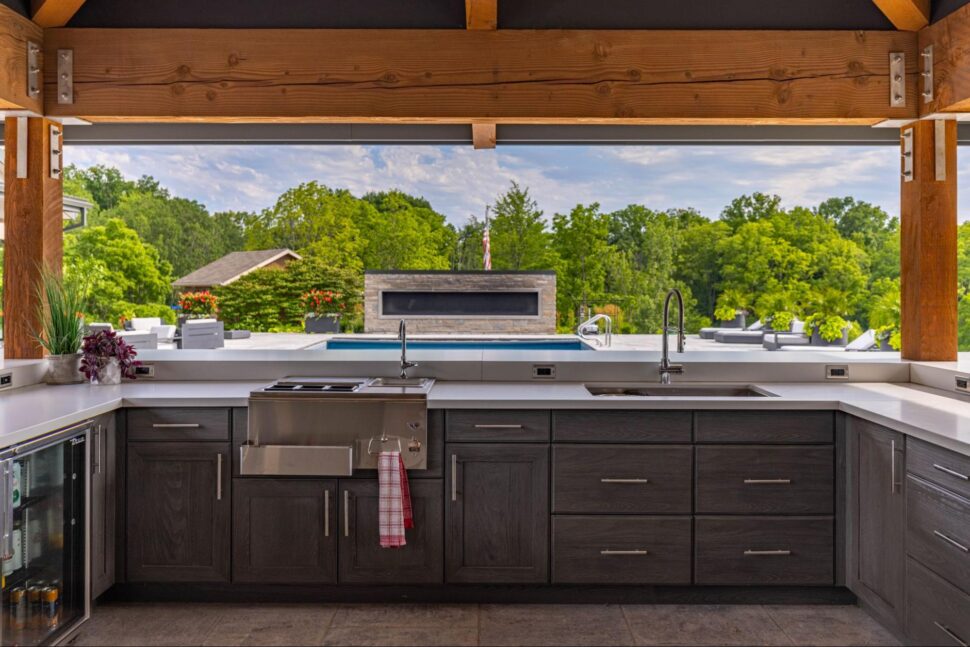
We’re talking about cabinetry that:
- Will not crack, split, or rot regardless of rain, humidity, heat, or cold
- Is UV-stable, so colors and finishes stay vibrant year after year
- Can literally be left out in the snow without damage
- Comes in a wide range of styles and finishes to match any outdoor kitchen aesthetic
- Is backed by a comprehensive warranty designed for outdoor environments
Pair NatureKast with a quality countertop, and you’ve built an outdoor kitchen that can genuinely last decades.
Build Your Dream Outdoor Kitchen with Materials from Standard Supply & Lumber
Ready to explore countertop and cabinetry options for your outdoor kitchen? Stop into one of our locations and get help from a friendly Standard Supply & Lumber expert. You can also contact us online before your trip to make sure we have what you’re looking for.